Tuesday, 11 July 2017

IBPS PO 2017 DAY 7


               Click Here To Download Our App


Study the following information carefully and answer the given questions.

There are seven national parks namely Jim Corbett, Ranthambore, Kaziranga, Periyar, Bandipur, Manas and Satpura located in different cities such as Chennai, Mumbai, Kochi, Hyderabad, Bangalore, Patna & Kolkata, not necessarily in the same order. Different animals such as, Lion, Tiger, Elephant and Deer were presented in the park. Depends on the length of the Parks it was listed from 1 to 7 positions, from top to bottom. The following information is known about them.
·        Not more than 3 Parks has same animals.
·        There's only one park has Deer which belongs to Bangalore and listed in bottom 3 positions and is not Kaziranga Park
·        The one belongs to Chennai listed just ahead of Ranthambore Park, which does not belong to Bangalore.
·        The park in which Tiger presented is listed 1st.
·        The Parks which listed in 3rd and 4th have same animals and it is not Lion.
·        The park located in Mumbai listed in last and park located in Patna listed as 4th and none of them are has Tiger.
·        Manas Park have Lion animal and is not in bottom 3.
·        Periyar Park belongs to Hyderabad and Satpura Park belongs to Chennai, both are not having lion animal and in the list there are two Parks between them.
·        The Parks from Kolkata and Mumbai are having same animals.
·        Bandipur Park not located in Kochi, Mumbai or Bangalore.


Study the following information carefully and answer the given questions.

Six friends - Harish, Mohan, Suresh, Vikram, Ram, and Gopal went to six different cities namely Mumbai, Bangalore, Hyderabad, Delhi, Chennai and Patna (not necessarily in the same order) to attend different probationary officers exam. They exams are IBPS PO, SBI PO, BOB PO, Syndicate Bank PO, Indian Bank PO and Dena Bank PO. They attend exams from Monday to Saturday (not necessarily in the same order).
·        Harish attends exam in Delhi and he wrote either IBPS PO or Dena Bank PO.
·        Ram did not wrote Dena Bank PO exam
·        Suresh attends exam on Tuesday and he is not wrote IBPS PO or BOB PO exam.
·        The person who wrote the Syndicate Bank PO exam wrote on Saturday and neither in Mumbai nor in Bangalore.
·        Gopal wrote the SBI PO exam in Patna but not on Wednesday.
·        Ram attends the exam at Hyderabad and wrote the exam one day before Gopal
·        On first day of the week, Mohan attends the exam in Bangalore.
·        The person who attends the exam on Thursday is not wrote BOB PO or IBPS PO exam.
·        The person who attends the exam on Thursday is not Gopal.


Directions (Q. 1-5): In each of the questions below there are given four conclusions followed by five statements numbered I, II, III, IV & IV. You have to take the given statements to be true even if they seem to be at variance with commonly known facts. Read all the statements and then decide which of the given statement logically follows from the given conclusion disregarding commonly known facts.

1). Conclusions:
Some cups are balls
Some pins are car is a possibility
Some rings are balls
Some balls are pins is a possibility
a)  Statements:
Some balls are cars
Some cars are rings
All rings are cups
Some cups are pins
b)  Statements:
Some cars are balls
All cars are rings
All rings are cups
Some cups are pins
c)  Statements:
All balls are cars
Some cars are rings
All rings are cups
Some cups are pins
d)  Statements:
Some balls are cars
All cars are rings
All rings are cups
No cup is a pin
e)  Statements:
All balls are cars
All cars are rings
All rings are cups
No cup is a pin
a)   Only I follows  
b)   Only II follows
c)   Only II & III follows
d)   Only IV follows
e)   Only V follows

2). Conclusions:
Some pencils are tables
All chairs are boxes
Some boxes are desk
All desks are pencils
a)  Statements:
Some desks are chairs
All chairs are tables
All tables are boxes
Some boxes are pencils
b)   Statements:
Some desks are chairs
No chair is table
All tables are boxes
All boxes are pencils
c)  Statements:
All desks are chairs
All chairs are tables
All tables are boxes
All boxes are pencils
d)  Statements:
All desks are chairs
All chairs are tables
No table is box
Some boxes are pencils
e)  Statements:
All desks are chairs
All chairs are tables
All tables are boxes
No box is pencil
a)   Only I follows  
b)   Only I & II follows
c)   Only III follows
d)   Only IV follows
e)   Only V follows

3). Conclusions:
Some rivers are not roads
Some jungles may be roads
Some cars are roads
Some rivers are trees
a)  Statements:
All roads are cars
No car is tree
All trees are jungles
All jungles are rivers
b)  Statements:
All roads are cars
Some cars are trees
All trees are jungles
Some jungles are not rivers
c)  Statements:
All roads are cars
No car is tree
Some trees are not jungles
All jungles are rivers
d)  Statements:
Some roads are cars
No car is tree
Some trees are not jungles
Some jungles are rivers
e)  Statements:
All roads are cars
No car is tree
Some trees are jungles
All jungles are rivers
a)   Only I follows  
b)   Only II follows
c)   Only II & III follows
d)   Only IV follows
e)   Only V follows


4). Conclusions:
Some pens are pins is a possibility
Some pencils are pads
Some papers are pads is a possibility
Some papers are pens
a)  Statements:
Some pens are papers
Some pencils are papers
Some pads are pencils
Some pins are pads
b)  Statements:
Some pens are papers
Some pencils are papers
No pad is a pencil
Some pins are pads
c)  Statements:
All pens are papers
Some pencils are papers
All pads are pencils
Some pins are pads
d)  Statements:
Some pens are papers
All papers are pencils
Some pads are not pencils
Some pins are pads
e)  Statements:
No pen is a paper
All papers are pencils
Some pads are pencil
Some pins are pads
a)   Only I follows  
b)   Only II follows
c)   Only II & III follows
d)   Only I & III follows
e)   Only IV & V follows

5). Conclusions:
All papers are cups
Some plates are cup is a possibility
Some cups are jugs
Some bottles are papers
a)  Statements:
All papers are bottles
Some bottles are cups
Some cups are jugs
Some jugs are plates
b)  Statements:
All papers are bottles
All bottles are cups
Some cups are jugs
Some jugs are plates
c)  Statements:
Some papers are bottles
Some bottles are cups
Some cups are jugs
Some jugs are plates
d)  Statements:
All papers are bottles
All bottles are cups
Some cups are not jugs
Some jugs are plates
e)  Statements:
Some papers are bottles
All bottles are cups
Some cups are jugs
Some jugs are plates
a)   Only I follows  
b)   Only II follows
c)   Only II & IV follows
d)   Only I & III follows
e)   Only V follows


PROFIT AND LOSS: PART-2

Type 6:
1). An article was purchased for Rs. 78,350/-. Its price was marked up by 30%. It was sold at a discount of 20% on the marked up price. What was the profit percent on the cost price?
Solution:
Cost Price = Rs.78350
Marked Price = 78350 x 130/100 = Rs.101855
Selling Price = 101855 x 80/100 = Rs.81484
Profit = 81484 – 78350 = 3134
Therefore Profit% = 3134/78350 x 100 = 4%

Type 7:
2). A shopkeeper purchases 12 balloons for Rs.10 and sells them at 10 balloons for Rs.12.Thus, he earns a profit of
Solution:
Number of Balloons purchased and sold be = LCM (12,10) = 60
CP = 60/12 x 10 = 50; SP = 60/10 x 12 = 72
Profit = (72 – 50)/50 x 100 = 22/50 x 100 = 44%

Type 8:
3). The cost price of an article is Rs. 800. After allowing a discount of 10%, a gain of 12.5% was made. Then the marked price of the article is
Solution:
CP = Rs 800
Gain% = 12.5%
SP = 800 + 12.5% of 800 = 800 + 25/200 x 800 = 800 + 100 = Rs 900
MP = SP + Discount
MP = 900 + 10% of MP
MP – MP/10 = 900
9MP/10 = 900
MP = (900 x 10)/9 = Rs 1000

Type 9:
4). If the selling price of an article is doubled, then its loss per cent is converted into equal profit per cent. The loss per cent on the article is
Solution:
Let CP = C, SP = S, Loss% = x %
=> x = (C – S)/C x 100 --------------(1)
When SP is doubled, loss% becomes profit%.
x = (2S – C)/C x 100 --------------(2)
From eqns (1) and (2)
2S – C = C – S
3S = 2C => S = 2/3 C
Substituting b = 2/3 a in eqn (1)
x = (C – 2/3 C)/C x 100= (C/3)/C x 100  = 100/3 = 33 1/3%

Type 10:
5). A man bought an article listed at Rs. 1500 with a discount of 20% offered on the list price. What additional discount must be offered to man to bring the net price to Rs. 1,104?
Solution:
SP of the article = MP – Discount = 1500 – 20% of 1500 = 1500 – 300 = Rs 1200
Therefore, additional discount = (1200 – 1104)/1200 x 100 = (96/1200) x 100 = 8%


Exercise Questions:
1). Giri purchased 100 shirts at Rs. 450 per piece. While selling he offered 10%discount on the labeled price and earned a profit of 20%. What was the labeled price of each shirt?
a)   Rs. 540
b)   Rs. 650
c)   Rs. 590
d)   Rs. 600
e)   None of these

2). If the cost price of 15 Pencils is equal to the selling price of 12 pencils, find gain percent.
a)   20
b)   25
c)   18
d)   21
e)   None of these

3). A dealer purchased a printing machine for Rs. 7660. He allows a discount of 12% on its marked price and still gains 10%. Find the marked price of the machine. 
a)   9575
b)   8765
c)   10985
d)   8995
e)   None of these

4). A fruit seller buys oranges at 2 for a rupee and sells them at 5 for three rupees. His gain percent is
a)   10%
b)   15%
c)   20%
d)   25%
e)   30%

5). The labeled price of a Juicer is Rs.620. If it is sold at 15% discount and the dealers earn a 20% profit, what is the cost price?
a)   Rs.439.16
b)   Rs.423.16
c)   Rs.412.16        
d)   Rs.436.11
e)   None of these

6). A person sold an toy for Rs. 136 and got 15% loss, had he sold it for Rs. N, he would have got a profit of 15%. Which one of the following is correct?
a)   190 < N < 200
b)   180 < N < 190
c)   170 < N < 180
d)   160 < N < 170
e)   None of these

7). A person bought an old Bike at Rs.7200 and spent 15% of it on repairing. If he wants to make a profit of Rs.648 then what percentage should be added to purchase price?
a)   15%       
b)   20%
c)   24%
d)   25%
e)   None of these

8). A shopkeeper gave an additional 40% discount on the reduced price after giving 25% standard concession on that item, if a person bought that item for Rs.1260, what is the original price of the item?
a)   Rs.2400
b)   Rs.2800
c)   Rs.3200
d)   Rs.2000
e)   None of these

9). 20 mangoes were bought for a rupee. Approximately how many mangoes must be sold for a rupee to gain a profit of 30%?
a)   12
b)   10
c)   15
d)   20
e)   25

10). A seller wants to earn 12% profit on an item after giving 20% discount to the customer. By what percentage should he increase his marked price to arrive at the label price?
a)   24%
b)   32%
c)   42%
d)   16%
e)   None of these

_____________________________________________

Answers with Explanation: Reasoning


Directions (Q. 1-5): Syllogism

1). B)

2). C)

3). A)

4). D)


5). D)


Answers with Explanation: MATH


1). Answer: d)
Let the labeled price of each shirt be Rs. x.
According to the question,
90% of x = 120 × 450 / 100
90 / 100 × x = 120 × 450 / 100
x = 120 × 450 / 90
x = Rs. 600

2). Answer: b)
Gain percent = (15 – 12) / 12 × 100 = 25%

3). Answer: a)
Cost price of the machine = Rs. 7660, Gain% = 10%.
Therefore, selling price = [{(100 + gain%)/100} × CP]
                                     = Rs. [{(100 + 10)/100} × 7660]
                                     = Rs. [(110/100) × 7660]
                                     = Rs. 8426.
Let the marked price be Rs. x.
Then, the discount = 12% of x
                               = {x × (12/100)}
                               = 3x/25
Therefore, SP = (Marked Price) - (discount)
                       = (x - 3x/25)
                       = 22x/25.
But, the SP = Rs. 8426.
Therefore, 22x/25 = 8426
⇒ x = (8426 × 25/22)
⇒ x = 9575.
Hence, the marked price of the Printing machine is Rs. 9575. 

4). Answer: c)
The cost price of 1 lemon =Rs.0 .50
Selling price of 1 lemon = Rs.0.60;  
Therefore,  profit = Rs.0.10
:.  Gain per cent = 0.10 × 100/0.50 = 20%.

5). Answer: a)
The selling price = Rs.620 – 15% of 620 = 620 – 93 = Rs.527
Rs.527 is 120% of the cost price;
Therefore, cost price = 527 × 100/120 = Rs.439.16.

6). Answer: b)
Cost price = (selling price x 100)/(100 - loss%)
= (136 x 100)/(100 - 15)
= (136 x 100)/85
= Rs. 160
Selling price (N) = 160 x (100 + 15)/100 = (160 x 115)/100
= Rs. 184
∴ Option (b) is correct because [180 < N < 190].

7). Answer: c)
CP = Rs.7200
CP + repair cost + profit expected = Rs.7200 + 1080 +648 = Rs.8928.
The amount to be added to CP = Rs.8928 – Rs.7200 = Rs.1728
The percentage of amount to be added to CP = 1728 x 100/7200 = 24%

8). Answer: b)
Let the original price be ‘x’
The price after 1st concession of 25% = x – 25x/100 = x – x/4 = 3x/4
The Price after additional discount 40% = 3x/4 – 3x/4 X 40/100 = 30x – 12x/40
= 9x/20, i.e. 9x/20 = Rs.1260,
:. x = 1260 x 20 /9 = Rs.2800.

9). Answer: c)
Given 20 mangoes cost 100 paisa.
:. 1 mango’s cost = 5 paisa.
For a getting a profit of 30% , the SP per mango should be equal to 6.5 paise.
:. For 1 Rupee, the No. of mangoes to be sold = 100/6.5
= 15 nos. approximately.


10). Answer: e)
Let x = marked price and the CP be Rs.100.
Initial SP = Rs.112.
To give 20% discount = x – 20x/100 = Rs.112.
= x – x/5 = Rs.112,  4x = 112 x 5
x = Rs.140.
Here marked profit = Rs.40.
Percent profit 40%


Monday, 10 July 2017

IBPS PO 2017 DAY 6

               Click Here To Download Our App  


Study the following information carefully and answer the given questions.
Seven persons, namely M, N, O, P, Q, R and S, like seven different cars, namely Volkswagen, Audi, BMW, Mercedes, Nissan, Jaguar and Fiat but not necessarily in the same order. They will also attend a screening not necessarily in the same order from Monday to Sunday (of the same week). M will attend a screening on Friday. Only one person will attend a screening between M and the one who likes Jaguar. Only two persons will attend a screening between R and the one who likes Jaguar. The one who likes Nissan will attend a screening immediately before N. Only three persons will attend a screening between the one who likes Nissan and O. Only one person will attend a screening between the one who likes Mercedes and O. Q does not like Nissan. S will attend the screening immediately before O. Only one person will attend a screening between Q and the one who likes Audi. Only two persons will attend a screening between the one who likes Volkswagen and the one who likes BMW. The one who likes BMW will attend the screening between the one who likes Audi and Fiat. N does not like Audi.


Study the following carefully and answer the questions given below. Germany, France, UK, Italy, Japan, USA, Canada and Russia are the members of G-8 committee sitting around a circular table facing the centre, but not necessarily in the same order. All the member countries have different cars at the venue. These cars are Porsche, McLaren, Hennessey Venom, Zenvo, Ferrari, Lamborghini, Aston Maruti and Bugatti, but not necessarily in the same order.
The President of Germany who does not come in Aston is sitting third to the right of the President of France. The President whose car is Porsche is sitting second to the right of Japan's President. The President who used Ferrari is sitting fourth to the right of the person coming in Hennessey Venom, which is owned by the Canadian President. The President of Italy is sitting opposite the President who is coming in Bugatti. The UK and Canadian presidents are the neighbours of the Italian president. The President of Russia is sitting fifth to the left and third to the right of the Italian President. 
There are two persons sitting between the USA President and the Canadian President. The President coming in Lamborghini is sitting second to the left of the USA President and the President coming in McLaren is sitting second to the right of the USA president. The President of a UK is coming in Zenvo.


Read the following information carefully and answer the questions given below. Eight persons A, B, C, D, E, F, G and H live in an eight-storey building. Each of them likes a different cars viz Duster, Thar, Safari, Wrangler, Eco sport, Ciaz, Beetle and Camry, but not necessarily in the same order. The lowermost floor is numbered 1 and the topmost floor is numbered 8. There is only one floor between the one who likes Safari and the one who likes Camry. There are two floors between the one who likes Thar and C. F lives on an even-numbered floor and likes Beetle. Neither A nor B likes Thar or Eco sport. The one who likes Wrangler lives on floor no. 1. There are three floors between the floor on which B lives and the floor on which E lives. F lives above C, who does not live on first floor but likes Duster. Only one person lives between the one who likes Eco sport and the one who likes Thar. The one who likes Safari lives on the topmost floor. H does not like Safari. G lives on the floor number which is between A and F. B lives above E and A.


PROFIT AND LOSS

Points to Remember:
Cost Price (CP): The price at which an article is brought, including all costs such as transportation, taxes, etc.
Selling Price (SP): The price at which an article is sold.
Profit or Gain: If selling price is greater than cost price, the seller makes profit or gain. Gain = SP – CP.
Loss: If the SP is less than the CP then seller makes loss. Loss = CP – SP

Basic Formulae:
i) Gain = SP - CP
ii) Loss = CP – SP
iii) Gain% = {[(SP – CP) x 100]/CP}
iv) Loss% = {[(CP – SP) x 100]/CP}
v) A person sells an item at x% loss (+ sign) or x% profit (- sign). Had he sold that item for Rs. X more his profit would have been y%. Then
CP = [X/(y±x) × 100)
vi) If there is a loss of x% on selling an item at selling price (SP1) and also there is a profit of y% on selling price (SP2) then
SP2 = [SP1(100 + y)/(100 – x)]
vii) When a person sells two similar items, one at a gain of say x%, and at a loss of x%, then the seller always incurs a loss given by:
Loss% = (Common Loss and Gain%/10)2 = (x/10)2
viii) If a trader professes to sell his goods at CP, but uses false weights, then,
Gain% = [Error/(True value – error)]x100%
ix) If the Cost price of M articles is equal to the selling price of N articles then the profit percent is given by
P = [(M – N)/N] x 100
Marked Price or List Price: Price that is indicated or marked on the article is called marked price or MP.
Discount: It is reduction given on the Marked Price or List Price of an article.
Discount% = discount/MP x 100%;
Selling Price = (100 – d)/100 x MP
x) If an article is sold after allowing two successive discounts of d1% and d2% then selling price (S.P) is given by
S.P = [(100 – d1)/100] x [(100 – d2)/100] x MP
xi) Two successive discounts of d1 and d2 are equivalent to a single discount of
d = d1 + d2 – (d1 x d2/100)

Solved Example Questions on Profit and Loss:
Type 1:
1. Pankaj purchased an item for Rs.7500 and sold it at the gain of 24%. From that amount he purchased another item and sold it at the loss of 20%. What is his overall gain or loss?
Solution:
CP1 = Rs.7500; SP1 = 7500 x 124/100 = Rs.9300 = CP2
SP2 = 9300 x 80/100 = 7440. Here CP1 > SP2 (Hence, loss is incurred here)
Therefore Loss = 7500 – 7440 = Rs.60


Type 2:
2. Vijay purchased a Washing machine and a Television for Rs.15,400 and Rs.19,600 respectively. He sold washing machine for a profit of 15 percent and the television for a loss of 20 percent. What is his overall loss/profit?
Solution:
CP of WM = 15400, P = 15%; CP of Tel = 19600, L = 20%
SP of WM = 115/100 x 15400 = 17710; SP of Tel = 80/100 x 19600 = 15680
Total CP = 15400 + 19600 = 35000
Total SP = 17710 + 15680 = 33390
Since CP is greater than SP loss is occurred. Loss = 35000 – 33390 = 1610 

Type 3:
3. If by selling an article for Rs 60, a person loses 1/7 of outlay (cost), what would he have gained or lost per cent by selling it for Rs.77?
Solution:
CP = SP/(1 – 1/7) = 60 x 7/6 = 70
Profit% = 77 – 70/70 x 100 = 10%

Type 4:
4. A producer of tea blends two varieties of tea from two tea gardens one costing Rs 18 per kg and another Rs 20 per kg in the ratio 5 : 3. If he sells the blended variety at Rs 21 per kg, then his gain percent is
Solution:
Suppose he bought 5 kg and 3 kg of tea
Cost Price = Rs. (5 x 18 + 3 x 20) = Rs. 150
Selling price = Rs. (8 x 21) = Rs. 168.
Profit = 168 - 150 = 18
So, Profit % = (18/150) * 100 = 12%

Type 5:
5. If books bought at prices ranging from Rs. 200 to Rs. 350 are sold at prices ranging from Rs. 300 to Rs. 425, what is the greatest possible profit that might be made in selling eight books?
Solution:
Least Cost Price = Rs. (200 * 8) = Rs. 1600.
Greatest Selling Price = Rs. (425 * 8) = Rs. 3400.
Required profit = Rs. (3400 - 1600) = Rs. 1800.

More Types on Profit and Loss Problems will be discussed in the next Session, Kindly follow us daily.


Exercise Questions:
1). Reha purchased a Scooty for Rs.54000/-. She sold it at a loss of 8 percent. With that money he again purchased another Scooty and sold it at a profit of 10 percent. What is his overall loss/profit?
a)   Loss of Rs.658/-
b)   Profit of Rs. 568/-
c)   Loss of Rs.638/-
d)   Profit of Rs.638/-
e)   None of these

2). Chandru purchased a Printer and a Washing machine or Rs.15400 and Rs.19600 respectively. He sold Printer for a profit of 15 percent and the Washing machine for a loss of 20 percent. What is his overall loss/profit?
a)   Loss of Rs.1620        
b)   Profit of Rs.1620
c)   Loss of Rs.1610
d)   No gain no loss
e)   Cannot be determined

3). By selling an book for Rs. 144, a shopkeeper loses 1 / 7 of his outlay. By selling it for Rs. 168, his gain or loss percent is ?
a)   20% loss
b)   20% gain
c)   4 1/ 6 % gain
d)   4 1/6 % loss
e)   None of these

4). Arun owns a house worth Rs. 100000. He sells it to Mathi at a profit of 10% based on the worth of the house Mathi sell the house back to Arun at a loss of 10%. In this transaction Arun gets ?
a)   No profit no loss
b)   Profit of Rs . 10000
c)   Profit of Rs . 11000
d)   Profit of Rs . 20000
e)   None of these

5). If articles bought at prices ranging from Rs. 150 to Rs. 300 are sold at prices ranging from Rs. 250 to Rs 350, what is the greatest possible profit that might be made in selling 15 articles ?
a)   Rs. 2500
b)   Rs. 3000
c)   Rs. 3500
d)   Rs. 4500
e)   None of Above

6). Neepa blends two varieties of fruits - one costing Rs. 180 per kg and another costing Rs. 200 per kg in the ratio 5 : 3. If she sells the blended variety at Rs. 210 per kg, then her gain is :
a)   10%
b)   12%
c)   11%
d)   13%
e)   None of these

7). A cashew nut seller mixes three varieties of nuts costing 50, 20 and 30 per kg in the ratio 2 : 4 : 3 in terms of weight and sells the mixture at 33 per kg. What percentage of profit does he make ?
a)   8%
b)   10%
c)   9%
d)   11%
e)   None of these

8). An apple is sold at a certain price. By selling it at 2/3 of that price one loses 10%. The gain percent at original price is ?
a)   20%
b)   33 1/3%
c)   35%
d)   40%
e)   None of these

9). A man sells a Pulsar Bike to his friend at 10% loss. If the friend sells it for Rs. 54000 and gains 20%, the original C.P. of the Bike was?
a)   Rs. 25000
b)   Rs. 37500
c)   Rs. 50000
d)   Rs. 60000
e)   None of these

10). A Seller purchased some notes from a publication worth Rs. 750. Because of some reasons, he had to sell two-fifth part of the book at a loss of 15%. On which gain he should sell his rest of the notes, so that he gets neither nor loss
a)   10%
b)   9%
c)   12%
d)   15%
e)   None of these


Answers with Explanation for Exercise Questions:
1). Answer: e)
1st SP = 2nd CP = Rs.54000 – 8% of Rs.54000.
= Rs.54000 – Rs.4320 = Rs.49680.
2nd  SP = Rs.49680 + 10% of Rs.49680
= Rs.49680 + Rs.4968 = Rs.54648.
:. Overall profit = 54648 – 54000 = Rs.648

2). Answer: c)
The total CP = Rs.15400 + Rs.19600 = Rs.35000
SP of Printer = 15400+ its 15% = 15400 + 2310 = Rs.17710.
SP of Washing machine = 19600 – its 20% = 19600-3920 = Rs.15680.
Total SP = 17710 + 15680 = Rs.33390
:. Overall loss = 35000 – 33390 = Rs.1610

3). Answer: e)
Let C.P. = Rs. P
S.P. = (C.P.) - (Loss) = P - P/7 = Rs. 6P/7
∵ 6P / 7 = 144
∴ P = (144 x 7) / 6 = Rs. 168
Hence, no Loss and no gain.

4). Answer: c)
C.P. of Mathi = 110% of Rs. 100000 = Rs. 110000
Loss of Mathi = 10%
S.P. of Mathi = 90% of Rs. 110000 = Rs. 99000
Thus, C.P. of Arun = Rs. 99000
So, Arun gets [(10% of Rs. 100000) + (100000 - 99000)] = Rs. 11000

5). Answer: b)
The greatest profit is possible only if the cost price of the articles is minimum and selling prices are maximum.
Let lowest cost price of the 15 articles = 150*15 = Rs. 2,250
Maximum selling price of 15 articles = 350 *15 = Rs. 5,250
So, maximum profit = 5250 - 2250 = Rs. 3,000

6). Answer: c)
Let 5 kg of cheaper be mixed with 3 kg of dearer.
Then, Total C.P. = Rs. (180 x 5 + 200 x 3) = Rs. 1500
Total S.P. = Rs. (210 x 8) = Rs. 1680
Gain % = (180/1500 x 100) % = 12%

7). Answer: c)
Let 2x, 4x and 3x kg of three varieties be mixed.
Then, C.P. = Rs. [(2x × 50) + (4x × 20) + (3x × 30)] = Rs. 270x
S.P. = Rs. [(2x + 4x + 3x) × 33] = Rs. 297x
Gain % = (27x / 270x × 100) % = 10%

8). Answer: c)
Let C.P. = Rs.100
S.P. at 10% loss = Rs. 90
∵ 2 / 3 of actual S.P. = Rs. 90
So, Actual S.P. = Rs. (90 x 3/2) = Rs. 135
∴ Gain = 35%

9). Answer: c)
∵ S.P. = Rs. 54000
Gain earned = 20%
∴ C.P. = Rs. (100/120) x 54000 = Rs. 45000
Now, S.P. = Rs. 45000
And Loss = 10%
∴ Original C.P. = Rs. (100/90) x 45000 = Rs. 50000

10). Answer: a)

Here, A = 2/5, R = 15%
According to the formula
Gain % = AR/(1 - A)%
= [(2/5) x 15]/[1 - (2/5)]%
= (6 x 5)/3%
= 10%


Sunday, 9 July 2017

Sitting Arrangement For Pre

             Click Here To Download Our App


Directions (Q. No. 1-5) : Study the following information carefully and answer the questions given below.

Praveen, Ravi, Raju, Suman, Tarun, Usha and Vishnu live in a seven storey building. Each one of them has a pet like Dog, Cat or Parrot. There are two cats, two parrots and three dogs in the building. The floors are numbered 1 to 7 bottom to top.

Ravi lives on floor number 5 and he does not have a cat. The person living on the lower most floor doesn't have a cat. Vishnu does not live below Praveen. Tarun owns neither a dog nor lives adjacent to the floors on which a dog lives. The person living on the topmost floor has a parrot. Both persons who have cats live immediately below the floors on which a person with a dog lives. Vishnu has a cat and Praveen has a dog. Raju has a dog and he does not live adjacent to a floor on which a person with a cat lives. Suman does not have a cat.


Directions (Q. No. 6 - 10) : Study the following information carefully and answer the questions given below.

10 persons A, B, C, D, E, F, G, H, K and L are sitting in a straight line. Five of them facing south while the rest facing north.

E is sitting third to the right of F and G is sitting third to the left of C. Neither C nor E is sitting at any of the extreme ends. C is facing south while F is facing north. G is sitting third to the right of K and both of them are facing in the same direction. The persons sitting at the extreme ends are facing opposite directions. A is sitting third to the right of B. F is sitting between G and B. D is sitting between A and C. Both D and E are facing north. G is sitting to the immediate left of F. K is sitting second to the right of L and D is sitting second to the right of H.


Directions (Q. No. 11-15) : Study the following information care-fully and answer the questions given below.

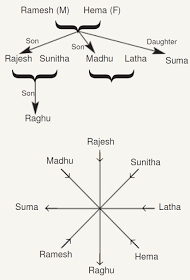
Eight members of a family, Ramesh, Raghu, Hema, Latha, Suma, Rajesh, Sunitha and Madhu are sitting around a circular table. Some of them are facing inside while some are facing outside the center.

The couples are facing inside while the singles are facing outside. Suma is the only daughter in the family and is sitting second to the right of her nephew. Suma is the daughter of Hema, who is sitting second to the right of her husband. Raghu is sitting opposite to his father and facing outside. Sunitha is the sister-in-law of both Madhu and Suma and also she is not the immediate neighbor of Madhu or Suma. Latha is sitting between Hema and Sunitha and it is the only group of three females sitting together. Madhu is facing his mother Hema and Sunitha is facing her father-in-law Ramesh.


Directions (Q.No.16-20) : Study the following information carefully and answer the given questions.

Ten friends Raman, Ratan, Ratna, Ratnesh, Ramesh, Rakesh, Rahul, Ravi, Roshan and Rajesh went for their physics viva one by one in a sequence. They went acco-rding to the assigned roll number 1-10 and they got marks 6, 7, 8, 9, 11, 12, 13, 14, 19 and 20 not necessarily in the same order.

Only Rakesh got the same mark as his roll number. Rakesh and Raman together marks equal to Rajesh's marks. Not more than 2 persons scored marks more than Rajesh's marks. Difference between Ratna's marks and her roll number is equal to the marks scored by Ratan. Not more than 4 persons scored more than Ratan marks. Rahul scored the maximum marks. Ravi's roll number was 8. Roshan scored 7 marks. One who scored 9 marks had a roll number 5. One who scored 14 had roll number 4. Sum of Roshan's marks and his roll number is equal to Ramesh's marks. Ratan gave his viva before Roshan. Rahul gave his viva just after Raman. Ravi scored marks more than Ratan.


 -------------------------SOLUTION-----------------------------


Saturday, 8 July 2017

IBPS PO 2017 DAY 5


               Click Here To Download Our App  


QUANTITATIVE APTITUDE


1) (√3 + 1)² = ? + √12
A. 2
B. 6
C. 3
D. 4
E. None of these


2) 621 ÷ 27 * 2 – 37 = √?
A. 3
B. 9
C. 81
D. 121
E. None of these


3) √? + 43 = √19881
A. 9216
B. 8464
C. 9604
D. 8836
E. None of these


4) 325 – (12)² + 75 = (?)² – 68
A. 324
B. 384
C. 12
D. 18
E. None of these


5) (62.5 * 14 * 5) ÷ 25 + 41 = (?)³
A. 4
B. 6
C. 5
D. 8
E. None of these


6) 48356 + 5412 – 736 = ? * 40
A. 1302.6
B. 1218.9
C. 1325.8
D. 1412.5
E. None of these


7) 538.24 – 193.42 + 343.91 = ?
A. 725.63
B. 851.13
C. 688.73
D. 648.63
E. None of these


8) (32.4 * 8 * 5 + 4) ÷ 26 + 14 = (?)²
A. 8
B. 2
C. 18
D. 12
E. None of these


9) 3/8 of 4/5 of 5/6 of 7450 = ?
A. 1862.5
B. 2862.5
C. 1634.5
D. 1734.5
E. None of these


10) 44616 ÷ √? = 143 * 6
A. 2504
B. 2704
C. 1504
D. 1404
E. None of these


            ________________________________


Puzzle 1

There are two rows Row I and Row II. A, B, C, D and E sit in Row I facing in South direction and P, Q, R, S and T sit in Row II facing in North direction. They like different cricketers. One of the cricketers is AB De Villiers. The following information is known about them.

i. E sits third to the left of C who either likes Chris Gayle or Sachin Tendulkar.

ii. B sits three places away from the one who faces T.

iii. The one who likes Shane Watson neither sits opposite to the one who likes Sachin Tendulkar nor A.

iv. R sits second to the right of the one who likes Misbah-Ul-Haq.

v. The people who like Virat Kohli and Ricky Ponting face towards each other and one of them is E.

vi. T doesn’t like Sachin Tendulkar and R doesn’t like Virat Kohli.

vii. S likes Hashim Amla and sits in front of the one who sits with C.

viii. D sits at the middle and likes MS Dhoni.

ix. Q who doesn’t sit with T faces C.

x. The one who likes Rohit Sharma sits at the right end in Row I according to the direction of people in Row I.

xi. A doesn’t like Shane Watson.


Puzzle 2

 There are nine people namely A, B, C, D, E, F, G, H and I sitting around a circular table out of which some are females and some are males. Some are facing towards the centre and some are facing away from the centre. The following information is known about them.

i. E’s neighbours face in same direction as that of C’s sister who is sitting to the immediate right of C.

ii. The female sitting between B and D is not E.

iii. E sits fourth to the right of F.

iv. F’s spouse is B.

v. I sits exactly between G and C and they face in opposite directions.

vi. G is a male sitting with two females and one of them has husband facing towards the centre who is sitting third to the left of B.

vii. The person sitting second to the left of H is the wife of H and they face in same direction.

viii. A’s immediate neighbours are G and B.

ix. I’s spouse sits second to the right of I.

x. D sits second to the left of B.

xi. The person 4th to the left of H sits faces in a direction opposite to that of H but same as D.


 ------------------Solution---------------------------------


GK For APDCL EXAM

Assam State GK for any Assam Govt. Exam PREP BY: OFFICERS' ACADMEY 1. National Game held in Assam – 2007 2. Guawahati tea auct...