Monday, 10 July 2017

IBPS PO 2017 DAY 6

               Click Here To Download Our App  


Study the following information carefully and answer the given questions.
Seven persons, namely M, N, O, P, Q, R and S, like seven different cars, namely Volkswagen, Audi, BMW, Mercedes, Nissan, Jaguar and Fiat but not necessarily in the same order. They will also attend a screening not necessarily in the same order from Monday to Sunday (of the same week). M will attend a screening on Friday. Only one person will attend a screening between M and the one who likes Jaguar. Only two persons will attend a screening between R and the one who likes Jaguar. The one who likes Nissan will attend a screening immediately before N. Only three persons will attend a screening between the one who likes Nissan and O. Only one person will attend a screening between the one who likes Mercedes and O. Q does not like Nissan. S will attend the screening immediately before O. Only one person will attend a screening between Q and the one who likes Audi. Only two persons will attend a screening between the one who likes Volkswagen and the one who likes BMW. The one who likes BMW will attend the screening between the one who likes Audi and Fiat. N does not like Audi.


Study the following carefully and answer the questions given below. Germany, France, UK, Italy, Japan, USA, Canada and Russia are the members of G-8 committee sitting around a circular table facing the centre, but not necessarily in the same order. All the member countries have different cars at the venue. These cars are Porsche, McLaren, Hennessey Venom, Zenvo, Ferrari, Lamborghini, Aston Maruti and Bugatti, but not necessarily in the same order.
The President of Germany who does not come in Aston is sitting third to the right of the President of France. The President whose car is Porsche is sitting second to the right of Japan's President. The President who used Ferrari is sitting fourth to the right of the person coming in Hennessey Venom, which is owned by the Canadian President. The President of Italy is sitting opposite the President who is coming in Bugatti. The UK and Canadian presidents are the neighbours of the Italian president. The President of Russia is sitting fifth to the left and third to the right of the Italian President. 
There are two persons sitting between the USA President and the Canadian President. The President coming in Lamborghini is sitting second to the left of the USA President and the President coming in McLaren is sitting second to the right of the USA president. The President of a UK is coming in Zenvo.


Read the following information carefully and answer the questions given below. Eight persons A, B, C, D, E, F, G and H live in an eight-storey building. Each of them likes a different cars viz Duster, Thar, Safari, Wrangler, Eco sport, Ciaz, Beetle and Camry, but not necessarily in the same order. The lowermost floor is numbered 1 and the topmost floor is numbered 8. There is only one floor between the one who likes Safari and the one who likes Camry. There are two floors between the one who likes Thar and C. F lives on an even-numbered floor and likes Beetle. Neither A nor B likes Thar or Eco sport. The one who likes Wrangler lives on floor no. 1. There are three floors between the floor on which B lives and the floor on which E lives. F lives above C, who does not live on first floor but likes Duster. Only one person lives between the one who likes Eco sport and the one who likes Thar. The one who likes Safari lives on the topmost floor. H does not like Safari. G lives on the floor number which is between A and F. B lives above E and A.


PROFIT AND LOSS

Points to Remember:
Cost Price (CP): The price at which an article is brought, including all costs such as transportation, taxes, etc.
Selling Price (SP): The price at which an article is sold.
Profit or Gain: If selling price is greater than cost price, the seller makes profit or gain. Gain = SP – CP.
Loss: If the SP is less than the CP then seller makes loss. Loss = CP – SP

Basic Formulae:
i) Gain = SP - CP
ii) Loss = CP – SP
iii) Gain% = {[(SP – CP) x 100]/CP}
iv) Loss% = {[(CP – SP) x 100]/CP}
v) A person sells an item at x% loss (+ sign) or x% profit (- sign). Had he sold that item for Rs. X more his profit would have been y%. Then
CP = [X/(y±x) × 100)
vi) If there is a loss of x% on selling an item at selling price (SP1) and also there is a profit of y% on selling price (SP2) then
SP2 = [SP1(100 + y)/(100 – x)]
vii) When a person sells two similar items, one at a gain of say x%, and at a loss of x%, then the seller always incurs a loss given by:
Loss% = (Common Loss and Gain%/10)2 = (x/10)2
viii) If a trader professes to sell his goods at CP, but uses false weights, then,
Gain% = [Error/(True value – error)]x100%
ix) If the Cost price of M articles is equal to the selling price of N articles then the profit percent is given by
P = [(M – N)/N] x 100
Marked Price or List Price: Price that is indicated or marked on the article is called marked price or MP.
Discount: It is reduction given on the Marked Price or List Price of an article.
Discount% = discount/MP x 100%;
Selling Price = (100 – d)/100 x MP
x) If an article is sold after allowing two successive discounts of d1% and d2% then selling price (S.P) is given by
S.P = [(100 – d1)/100] x [(100 – d2)/100] x MP
xi) Two successive discounts of d1 and d2 are equivalent to a single discount of
d = d1 + d2 – (d1 x d2/100)

Solved Example Questions on Profit and Loss:
Type 1:
1. Pankaj purchased an item for Rs.7500 and sold it at the gain of 24%. From that amount he purchased another item and sold it at the loss of 20%. What is his overall gain or loss?
Solution:
CP1 = Rs.7500; SP1 = 7500 x 124/100 = Rs.9300 = CP2
SP2 = 9300 x 80/100 = 7440. Here CP1 > SP2 (Hence, loss is incurred here)
Therefore Loss = 7500 – 7440 = Rs.60


Type 2:
2. Vijay purchased a Washing machine and a Television for Rs.15,400 and Rs.19,600 respectively. He sold washing machine for a profit of 15 percent and the television for a loss of 20 percent. What is his overall loss/profit?
Solution:
CP of WM = 15400, P = 15%; CP of Tel = 19600, L = 20%
SP of WM = 115/100 x 15400 = 17710; SP of Tel = 80/100 x 19600 = 15680
Total CP = 15400 + 19600 = 35000
Total SP = 17710 + 15680 = 33390
Since CP is greater than SP loss is occurred. Loss = 35000 – 33390 = 1610 

Type 3:
3. If by selling an article for Rs 60, a person loses 1/7 of outlay (cost), what would he have gained or lost per cent by selling it for Rs.77?
Solution:
CP = SP/(1 – 1/7) = 60 x 7/6 = 70
Profit% = 77 – 70/70 x 100 = 10%

Type 4:
4. A producer of tea blends two varieties of tea from two tea gardens one costing Rs 18 per kg and another Rs 20 per kg in the ratio 5 : 3. If he sells the blended variety at Rs 21 per kg, then his gain percent is
Solution:
Suppose he bought 5 kg and 3 kg of tea
Cost Price = Rs. (5 x 18 + 3 x 20) = Rs. 150
Selling price = Rs. (8 x 21) = Rs. 168.
Profit = 168 - 150 = 18
So, Profit % = (18/150) * 100 = 12%

Type 5:
5. If books bought at prices ranging from Rs. 200 to Rs. 350 are sold at prices ranging from Rs. 300 to Rs. 425, what is the greatest possible profit that might be made in selling eight books?
Solution:
Least Cost Price = Rs. (200 * 8) = Rs. 1600.
Greatest Selling Price = Rs. (425 * 8) = Rs. 3400.
Required profit = Rs. (3400 - 1600) = Rs. 1800.

More Types on Profit and Loss Problems will be discussed in the next Session, Kindly follow us daily.


Exercise Questions:
1). Reha purchased a Scooty for Rs.54000/-. She sold it at a loss of 8 percent. With that money he again purchased another Scooty and sold it at a profit of 10 percent. What is his overall loss/profit?
a)   Loss of Rs.658/-
b)   Profit of Rs. 568/-
c)   Loss of Rs.638/-
d)   Profit of Rs.638/-
e)   None of these

2). Chandru purchased a Printer and a Washing machine or Rs.15400 and Rs.19600 respectively. He sold Printer for a profit of 15 percent and the Washing machine for a loss of 20 percent. What is his overall loss/profit?
a)   Loss of Rs.1620        
b)   Profit of Rs.1620
c)   Loss of Rs.1610
d)   No gain no loss
e)   Cannot be determined

3). By selling an book for Rs. 144, a shopkeeper loses 1 / 7 of his outlay. By selling it for Rs. 168, his gain or loss percent is ?
a)   20% loss
b)   20% gain
c)   4 1/ 6 % gain
d)   4 1/6 % loss
e)   None of these

4). Arun owns a house worth Rs. 100000. He sells it to Mathi at a profit of 10% based on the worth of the house Mathi sell the house back to Arun at a loss of 10%. In this transaction Arun gets ?
a)   No profit no loss
b)   Profit of Rs . 10000
c)   Profit of Rs . 11000
d)   Profit of Rs . 20000
e)   None of these

5). If articles bought at prices ranging from Rs. 150 to Rs. 300 are sold at prices ranging from Rs. 250 to Rs 350, what is the greatest possible profit that might be made in selling 15 articles ?
a)   Rs. 2500
b)   Rs. 3000
c)   Rs. 3500
d)   Rs. 4500
e)   None of Above

6). Neepa blends two varieties of fruits - one costing Rs. 180 per kg and another costing Rs. 200 per kg in the ratio 5 : 3. If she sells the blended variety at Rs. 210 per kg, then her gain is :
a)   10%
b)   12%
c)   11%
d)   13%
e)   None of these

7). A cashew nut seller mixes three varieties of nuts costing 50, 20 and 30 per kg in the ratio 2 : 4 : 3 in terms of weight and sells the mixture at 33 per kg. What percentage of profit does he make ?
a)   8%
b)   10%
c)   9%
d)   11%
e)   None of these

8). An apple is sold at a certain price. By selling it at 2/3 of that price one loses 10%. The gain percent at original price is ?
a)   20%
b)   33 1/3%
c)   35%
d)   40%
e)   None of these

9). A man sells a Pulsar Bike to his friend at 10% loss. If the friend sells it for Rs. 54000 and gains 20%, the original C.P. of the Bike was?
a)   Rs. 25000
b)   Rs. 37500
c)   Rs. 50000
d)   Rs. 60000
e)   None of these

10). A Seller purchased some notes from a publication worth Rs. 750. Because of some reasons, he had to sell two-fifth part of the book at a loss of 15%. On which gain he should sell his rest of the notes, so that he gets neither nor loss
a)   10%
b)   9%
c)   12%
d)   15%
e)   None of these


Answers with Explanation for Exercise Questions:
1). Answer: e)
1st SP = 2nd CP = Rs.54000 – 8% of Rs.54000.
= Rs.54000 – Rs.4320 = Rs.49680.
2nd  SP = Rs.49680 + 10% of Rs.49680
= Rs.49680 + Rs.4968 = Rs.54648.
:. Overall profit = 54648 – 54000 = Rs.648

2). Answer: c)
The total CP = Rs.15400 + Rs.19600 = Rs.35000
SP of Printer = 15400+ its 15% = 15400 + 2310 = Rs.17710.
SP of Washing machine = 19600 – its 20% = 19600-3920 = Rs.15680.
Total SP = 17710 + 15680 = Rs.33390
:. Overall loss = 35000 – 33390 = Rs.1610

3). Answer: e)
Let C.P. = Rs. P
S.P. = (C.P.) - (Loss) = P - P/7 = Rs. 6P/7
∵ 6P / 7 = 144
∴ P = (144 x 7) / 6 = Rs. 168
Hence, no Loss and no gain.

4). Answer: c)
C.P. of Mathi = 110% of Rs. 100000 = Rs. 110000
Loss of Mathi = 10%
S.P. of Mathi = 90% of Rs. 110000 = Rs. 99000
Thus, C.P. of Arun = Rs. 99000
So, Arun gets [(10% of Rs. 100000) + (100000 - 99000)] = Rs. 11000

5). Answer: b)
The greatest profit is possible only if the cost price of the articles is minimum and selling prices are maximum.
Let lowest cost price of the 15 articles = 150*15 = Rs. 2,250
Maximum selling price of 15 articles = 350 *15 = Rs. 5,250
So, maximum profit = 5250 - 2250 = Rs. 3,000

6). Answer: c)
Let 5 kg of cheaper be mixed with 3 kg of dearer.
Then, Total C.P. = Rs. (180 x 5 + 200 x 3) = Rs. 1500
Total S.P. = Rs. (210 x 8) = Rs. 1680
Gain % = (180/1500 x 100) % = 12%

7). Answer: c)
Let 2x, 4x and 3x kg of three varieties be mixed.
Then, C.P. = Rs. [(2x × 50) + (4x × 20) + (3x × 30)] = Rs. 270x
S.P. = Rs. [(2x + 4x + 3x) × 33] = Rs. 297x
Gain % = (27x / 270x × 100) % = 10%

8). Answer: c)
Let C.P. = Rs.100
S.P. at 10% loss = Rs. 90
∵ 2 / 3 of actual S.P. = Rs. 90
So, Actual S.P. = Rs. (90 x 3/2) = Rs. 135
∴ Gain = 35%

9). Answer: c)
∵ S.P. = Rs. 54000
Gain earned = 20%
∴ C.P. = Rs. (100/120) x 54000 = Rs. 45000
Now, S.P. = Rs. 45000
And Loss = 10%
∴ Original C.P. = Rs. (100/90) x 45000 = Rs. 50000

10). Answer: a)

Here, A = 2/5, R = 15%
According to the formula
Gain % = AR/(1 - A)%
= [(2/5) x 15]/[1 - (2/5)]%
= (6 x 5)/3%
= 10%


Sunday, 9 July 2017

Sitting Arrangement For Pre

             Click Here To Download Our App


Directions (Q. No. 1-5) : Study the following information carefully and answer the questions given below.

Praveen, Ravi, Raju, Suman, Tarun, Usha and Vishnu live in a seven storey building. Each one of them has a pet like Dog, Cat or Parrot. There are two cats, two parrots and three dogs in the building. The floors are numbered 1 to 7 bottom to top.

Ravi lives on floor number 5 and he does not have a cat. The person living on the lower most floor doesn't have a cat. Vishnu does not live below Praveen. Tarun owns neither a dog nor lives adjacent to the floors on which a dog lives. The person living on the topmost floor has a parrot. Both persons who have cats live immediately below the floors on which a person with a dog lives. Vishnu has a cat and Praveen has a dog. Raju has a dog and he does not live adjacent to a floor on which a person with a cat lives. Suman does not have a cat.


Directions (Q. No. 6 - 10) : Study the following information carefully and answer the questions given below.

10 persons A, B, C, D, E, F, G, H, K and L are sitting in a straight line. Five of them facing south while the rest facing north.

E is sitting third to the right of F and G is sitting third to the left of C. Neither C nor E is sitting at any of the extreme ends. C is facing south while F is facing north. G is sitting third to the right of K and both of them are facing in the same direction. The persons sitting at the extreme ends are facing opposite directions. A is sitting third to the right of B. F is sitting between G and B. D is sitting between A and C. Both D and E are facing north. G is sitting to the immediate left of F. K is sitting second to the right of L and D is sitting second to the right of H.


Directions (Q. No. 11-15) : Study the following information care-fully and answer the questions given below.

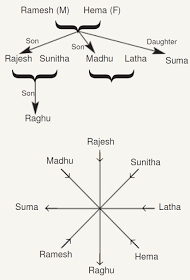
Eight members of a family, Ramesh, Raghu, Hema, Latha, Suma, Rajesh, Sunitha and Madhu are sitting around a circular table. Some of them are facing inside while some are facing outside the center.

The couples are facing inside while the singles are facing outside. Suma is the only daughter in the family and is sitting second to the right of her nephew. Suma is the daughter of Hema, who is sitting second to the right of her husband. Raghu is sitting opposite to his father and facing outside. Sunitha is the sister-in-law of both Madhu and Suma and also she is not the immediate neighbor of Madhu or Suma. Latha is sitting between Hema and Sunitha and it is the only group of three females sitting together. Madhu is facing his mother Hema and Sunitha is facing her father-in-law Ramesh.


Directions (Q.No.16-20) : Study the following information carefully and answer the given questions.

Ten friends Raman, Ratan, Ratna, Ratnesh, Ramesh, Rakesh, Rahul, Ravi, Roshan and Rajesh went for their physics viva one by one in a sequence. They went acco-rding to the assigned roll number 1-10 and they got marks 6, 7, 8, 9, 11, 12, 13, 14, 19 and 20 not necessarily in the same order.

Only Rakesh got the same mark as his roll number. Rakesh and Raman together marks equal to Rajesh's marks. Not more than 2 persons scored marks more than Rajesh's marks. Difference between Ratna's marks and her roll number is equal to the marks scored by Ratan. Not more than 4 persons scored more than Ratan marks. Rahul scored the maximum marks. Ravi's roll number was 8. Roshan scored 7 marks. One who scored 9 marks had a roll number 5. One who scored 14 had roll number 4. Sum of Roshan's marks and his roll number is equal to Ramesh's marks. Ratan gave his viva before Roshan. Rahul gave his viva just after Raman. Ravi scored marks more than Ratan.


 -------------------------SOLUTION-----------------------------


Saturday, 8 July 2017

IBPS PO 2017 DAY 5


               Click Here To Download Our App  


QUANTITATIVE APTITUDE


1) (√3 + 1)² = ? + √12
A. 2
B. 6
C. 3
D. 4
E. None of these


2) 621 ÷ 27 * 2 – 37 = √?
A. 3
B. 9
C. 81
D. 121
E. None of these


3) √? + 43 = √19881
A. 9216
B. 8464
C. 9604
D. 8836
E. None of these


4) 325 – (12)² + 75 = (?)² – 68
A. 324
B. 384
C. 12
D. 18
E. None of these


5) (62.5 * 14 * 5) ÷ 25 + 41 = (?)³
A. 4
B. 6
C. 5
D. 8
E. None of these


6) 48356 + 5412 – 736 = ? * 40
A. 1302.6
B. 1218.9
C. 1325.8
D. 1412.5
E. None of these


7) 538.24 – 193.42 + 343.91 = ?
A. 725.63
B. 851.13
C. 688.73
D. 648.63
E. None of these


8) (32.4 * 8 * 5 + 4) ÷ 26 + 14 = (?)²
A. 8
B. 2
C. 18
D. 12
E. None of these


9) 3/8 of 4/5 of 5/6 of 7450 = ?
A. 1862.5
B. 2862.5
C. 1634.5
D. 1734.5
E. None of these


10) 44616 ÷ √? = 143 * 6
A. 2504
B. 2704
C. 1504
D. 1404
E. None of these


            ________________________________


Puzzle 1

There are two rows Row I and Row II. A, B, C, D and E sit in Row I facing in South direction and P, Q, R, S and T sit in Row II facing in North direction. They like different cricketers. One of the cricketers is AB De Villiers. The following information is known about them.

i. E sits third to the left of C who either likes Chris Gayle or Sachin Tendulkar.

ii. B sits three places away from the one who faces T.

iii. The one who likes Shane Watson neither sits opposite to the one who likes Sachin Tendulkar nor A.

iv. R sits second to the right of the one who likes Misbah-Ul-Haq.

v. The people who like Virat Kohli and Ricky Ponting face towards each other and one of them is E.

vi. T doesn’t like Sachin Tendulkar and R doesn’t like Virat Kohli.

vii. S likes Hashim Amla and sits in front of the one who sits with C.

viii. D sits at the middle and likes MS Dhoni.

ix. Q who doesn’t sit with T faces C.

x. The one who likes Rohit Sharma sits at the right end in Row I according to the direction of people in Row I.

xi. A doesn’t like Shane Watson.


Puzzle 2

 There are nine people namely A, B, C, D, E, F, G, H and I sitting around a circular table out of which some are females and some are males. Some are facing towards the centre and some are facing away from the centre. The following information is known about them.

i. E’s neighbours face in same direction as that of C’s sister who is sitting to the immediate right of C.

ii. The female sitting between B and D is not E.

iii. E sits fourth to the right of F.

iv. F’s spouse is B.

v. I sits exactly between G and C and they face in opposite directions.

vi. G is a male sitting with two females and one of them has husband facing towards the centre who is sitting third to the left of B.

vii. The person sitting second to the left of H is the wife of H and they face in same direction.

viii. A’s immediate neighbours are G and B.

ix. I’s spouse sits second to the right of I.

x. D sits second to the left of B.

xi. The person 4th to the left of H sits faces in a direction opposite to that of H but same as D.


 ------------------Solution---------------------------------


Friday, 7 July 2017

IBPS PO 2017 DAY 4


               Click Here To Download Our App   

    REASONING
---------------------------
I. Study the following information carefully to answer the given questions.

Eight persons are sitting in two parallel rows containing four persons each in such a way that there is an equal distance between adjacent persons. In Row-1, P, Q, R and S are seated and all of them are facing south. In Row – 2, A, B, C, and D are seated and all of them are facing north. Therefore in the given seating arrangement each person seated in a row faces another person of the other row. Each of them belongs to different places viz., Delhi, Jaipur, Patna, Pune, Mumbai, Chennai, Shillong and Surat, but not necessarily in the same order. Each of them likes different subjects like Electronics, Commerce, Zoology, Chemistry, Botany, Physics, Biotechnology and Economics.

The person from Delhi is second to the right of the person who faces C. The immediate neighbour of person from Delhi faces the person from Patna. Only one person sits between person from Patna and B. One who faces B is second to the left of P. One who is immediate neighbour of B faces person from Jaipur. A person facing the person from Jaipur is second to the right of the person from Pune. There is only one person between the person from Jaipur and S. R faces the person from Surat. R is neither from Jaipur nor Mumbai. The person who is immediate neighbour of D is from Shillong. D is not an immediate neighbour of B. The one who likes Economics faces the one who likes Electronics. only one sits between the one who likes Commerce and the one who likes Zoology. The one who likes Chemistry is an immediate neighbour of one who like Physics and the one who likes Botany. A likes Electronics. P does not like Neither Commerce nor Zoology. The one who likes Commerce is an immediate neighbor of the person from Pune. The one who likes Zoology faces the one who likes Botany.


II. Study the following information carefully to answer the given questions.

Eight persons – J, K, L, M, N, O, P, Q are sitting around a circular table facing the centre with equal distances between each other(but not necessarily in the same order). Each of them is also related to N in some way or the other. Each of them also likes eight different colours namely viz – White, Black, Blue, Brown, Pink, Violite, Purple and Green.
K sits third to the left of N. Only one person sits between N and Q. N’s sister sits to the immediate right of Q. Only two people sit between N’s sister and N’s mother. J sits to the immediate right of N’s mother. P sits to the immediate right of M. N’s brother sits third to the right of P. N’s wife sits second to the left of N’s brother. Only three people sit between N’s wife and L. N’s son sits second to the right of N’s father. Only two people sit between N’s father and N’s daughter. Four people sit between the one who likes Violite and the one who likes Brown. The person who likes Violite sits immediate right/left of the N’s Sister. The person who likes Brown sits exactly between the one who likes Green and the one who likes Black. Three persons are there between the one who likes Green and the one who likes Blue. The person who likes Violite sits exactly between the one who likes White and the one who likes Purple. Only one person sits between the one who likes Purple and Pink. N does not like Violite and K does not like Purple.


Study the following information carefully and answer the questions given below:

A is the daughter of E. F has only two children – A and G. H is the brother of I. G is married to K. F has only two daughters. M is the mother of E. H is married to A. M is married to N. F is the son of O.

Who among the following is the father of E?
A. M
B. O
C. F
D. N
E. None of these

Who among the following is the sister-in-law of I?
A. G
B. A
C. E
D. M
E. O

How is F related to H?
A. Father-in-law
B. Mother-in-law
C. Father
D. Mother
E. Brother


     QUANTITATIVE APTITUDE
---------------------------------------------------


Q1. The mean marks of 10 boys in a class is 70%, whereas the mean marks of 15 girls is 60%. The mean marks of all the 25 students is:
(a) 64%
(b) 60%
(c) 55%
(d) 52%
(e) None of these

Q2. A number, x equals 80% of the average of 5, 7, 14 and a number y. If the average of x and y is 26, then value of y is:
(a) 13
(b) 26
(c) 39
(d) 12
(e) None of these

Q3. The average monthly expenditure of a family for the first four months is Rs. 2750, for the next three months is Rs. 2940, and for the last five months Rs. 3130. If the family saves Rs.  5350 throughout year, find the average monthly income of the family for the year.
(a) Rs. 3800
(b) Rs. 3500
(c) Rs. 3400
(d) Rs. 4200
(e) None of these

Q4. In a competitive examination, the average marks obtained was 45. It was later discovered that there was some error in computerization and the marks of 90 candidates had to be changed from 80 to 50, and the average came down to 40 marks. The total number of candidates appeared in the examination is
(a) 520
(b) 550
(c) 540
(d) 525
(e) None of these

Q5. The average age of students of a class is 15.8 years. The average age of boys in the class in 16.4 years and that of the girls is 15.4 years. The ratio of number of boys to the number of girls in the class is:
(a) 1 : 2
(b) 3 : 4
(c) 3 : 5
(d) 2 : 3
(e) None of these

Q6. The average salary of all the workers in a workshop is Rs. 8000. The average salary of 7 technicians is Rs. 12000 and the average salary of the rest is Rs. 6000. The total number of workers in the workshop is:
(a) 20
(b) 21
(c) 23
(d) 22
(e) None of these

Q7. The average of 7 consecutive numbers is 20. The largest of these numbers is:
(a) 24
(b) 23
(c) 22
(d) 20
(e) None of these

Q8. The average weight of three men A, B and C is 84 Kg. D joins them and the average weight of the four becomes 80 Kg. If E, whose weight is 3 Kg more than that of D, replaces A, the average weight of B, C, D and E becomes 79 Kg. The weight of A is:
(a) 65 Kg
(b) 70 Kg
(c) 75 Kg
(d) 80 Kg
(e) None of these

Q9. Average age of seven persons in a group is 30 years. The average age of five persons of this group is 31 years. What is the average age of the other two persons in the group?
(a) 55 years
(b) 26.5 years
(c) 15 years
(d) 27.5 years
(e) None of these

Q10. 12% of Kaushal’s monthly salary is equal to 16% of Nandini’s monthly salary. Suresh’s monthly salary is half that of Nandini’s monthly salalry. If Suresh’s annual salary is Rs. 1.08 lacs. What is Kaushal’s monthly salary?
(a) Rs. 20000
(b) Rs. 18000
(c) Rs. 26000
(d) Rs. 24000
(e) None of these


         SOLUTIONS
__________________________________________________


Reasoning
-------------------


 QUANTITATIVE APTITUDE
------------------------------------------------


1) A. Sol. The mean marks of 10 boys = 70%
Total marks of 10 boys = 70% × 10 = 700
The mean marks of 15 girls = 60%
Total marks of 15 girls = 60% × 15 = 900
∴ Sum of the total marks of 25 students = 700 + 900 = 1600
∴ The mean marks of all the 25 students =1600/25=64%  

2) C.

3) C.  Total expenditure for 4 months = Rs. 2750 × 4 = Rs. 11000
Total expenditure for 3 months = Rs. 2940 × 3 = Rs. 8820   …(i)
Total expenditure of 5 months = Rs. 3130 × 5= Rs. 15650  …(ii)
Total expenditure in the whole year = Rs. 11000 + 8820 + Rs. 15650
= Rs. 35470.
Saving during the whole year = Rs. 5330
Total income of the family during the year
= Rs. 35470 + Rs. 5330 = Rs. 40800
∴ Average monthly income during the year
=40800/12= Rs. 3400

4) C

5) D  

6) B.

7) B.

8) C. Sum of weights of A, B and C = 84 × 3 kg = 252 kg
Weight of D = 4 × 80 – 252
= 320 – 252 = 68 kg
Weight of E = 68 + 3 = 71 kg
A + B + C + D = 320
B + C + D + E = 79 × 4 = 316
⇒ A – E = 4 kg
∴ A = 4 + E = 4 + 71 = 75 kg.

9) D.  The total age of 7 person = 30 × 7 = 210 years.
Total age of 5 persons = 31 × 5 = 155 years.
∴ The total age of 2 persons = (210 – 155) years = 55 years.
∴ The average age of two persons =55/2=27.5 years

10) D.


Thursday, 6 July 2017

IBPS PO 2017 DAY 3..

       Click Here To Download Our App   


      REASONING
-----------------------------

I. Study the following information carefully to answer the given questions

Seven People – A, B, C, D, E, F, and G live in eight different floors of the building (but not necessarily in the same order). One of the floors in the building is vacant. The lowermost floor of the building is numbered one, the one above that is numbered two, and so on till the topmost floor is numbered eight. Each one of them also owns different brands of laptops, namely Lenovo, Dell, HP, Samsung, Apple, Asus and TOSHIBA (but not necessarily in the same order).

The number of people leaving above F is same as the number of floors between F and D. F lives an odd numbered floor above the floor numbered four. Only one person lives between B and the one who owns Samsung. Only three floors between D and the one who owns Apple. The one who owns Asus lives immediately above G, G owns neither Apple nor HP. E does not own Asus. Only three floors between G and A. The one who owns TOSHIBA lives immediately above the one who owns Lenovo, but not on the topmost floor. C lives one of the odd numbered floors above the one who owns Apple. The number of floors between F and the one who owns DELL is only one. Only one person lives between the one who owns TOSHIBA and the vacant floor. Only two people live between C and vacant floor. Two persons live between the one who likes Black colour and the one who likes Yellow Colour. Only one person lives between the one who likes Yellow and the one who likes White. There are two floors between the one who likes Orange and Brown. Four persons live between the one who likes Red and Blue. The one who likes Yellow colour lives on one of the floors above the floor numbered four. The person who lives on the sixth floor does not like white. The one who likes Red colour lives immediately above the one who likes Orange.


II. Study the following information carefully to answer the given questions

Seven students namely viz A, B, C, D, E, F and G of seven different colleges have the seminar on seven different days, namely viz Monday, Tuesday, Wednesday, Thursday, Friday, Saturday and Sunday of the same week but necessarily in the same order. Each student stays in a hostel in different floor. The lowermost floor of the building is numbered 1, the one above that is numbered 2 and so on till the topmost floor is numbered 7.
G stayed on the second floor and has a seminar on Wednesday. The one who stayed on the first floor has a seminar on Saturday. B has a seminar immediately before E. B does not have the seminar on any of the days after G. The one who stayed on the seventh floor does not have a seminar on any of the days on or before Friday. The one who stayed on the third floor has a seminar immediately after C. E does not stay on the fifth floor. The one who stays on the sixth floor does not have a seminar immediately before or after G. F does not have any seminar on Sunday and does not live on the third floor. D does not have the seminar on any one of the days before A. Two persons live between the one who likes 5Star and the one who likes Kitkat. Only one person lives between the one who likes Kitkat and the one who likes Munch. Two persons live between the one who likes Munch and Snickers. Four persons live between the one who likes Dairy Milk and Bournville. The one who likes 5star lives on one of the floors above the floor numbered three. The persons who live on the fourth and fifth floor don’t like Snickers. The one who likes Munch lives immediately below the one who likes Dairy Milk.


Direction: Q(1-5) There are 5 friends A, B, C, D and E standing randomly. B is to the northeast of E. D is 2km to the east of E, who is 4km to the west of A. C is to the northwest of D and in the line of EB. D is 4km the south of B.

In which direction is C with respect to A ?
A.South west
B.South east
C.Northeast
D.Northwest
E.None of these


In which direction is A with respect to B ?
A.Southeast
B.Southwest
C.Northwest
D.Northeast
E.None of these


What is the distance between D and A ?
A.5km
B.4km
C.6km
D.3km
E.None of these


What is the shortest distance between B and A?
A.5√7km
B.4√2km
C.6√2km
D.3√5km
E.None of these


What is the shortest distance between between B and E?
A.2√7km
B.5 √2km
C.7√2km
D.2√5km
E.None of these


   ENGLISH
----------------------

1. A. The millionaire has __________ Rs. 10,00,000 for this priceless artefact.
B. In a/an __________ to rescue the child who was caught in fire, she sustained burns.
C. I went to the railway station to __________ goodbye to my friend.
D. I was asked to __________ a price by the auctioneer.
(a) quoted
(b) attempt
(c) bid
(d) say
(e) spend

2. A. Many students still __________ around the college, even after the classes are over.
B. Every citizen of India should __________ his head in shame at the brutal killings in the name of religion.
C. There is ample space in the wardrobe for you to __________ your clothes.
D. “__________ the perpetrators of the crime!” shouted the angry mob.
(a) execute
(b) loiter
(c) hang
(d) bend
(e) store

3. A. Akbar was known for his benevolence, people were happy during his __________.
B. Cleopatra has an ambion to __________ the world as a queen of beauty.
C. Beer to __________ in hell than to serve in heaven.
D. One should not allow indolence to __________ over oneself.
(a) reign
(b) dominate
(c) rule
(d) tenure
(e) overpower

4. A. For many years India was __________ in a tricky situaon, whether to go in for a nuclear weapon or not.
B. The marathon innings of the batsman came to an end when he was finally __________ by the same bowler who troubled him the most.
C. The notorious burglar was finally __________ by the cops.
D. I was __________ unaware when my photograph was clicked.
(a) held
(b) seized
(c) apprehended
(d) caught
(e) trapped

5. A. India and Russia __________ an excellent bilateral relaonship.
B. Due to a crash in the overseas market, __________ market in India was also badly affected.
C. According to the law, women are also entled
to a __________ in the ancestral property.
D. Every job has its own __________ of problems.
(a) stock
(b) poron
(c) posses
(d) share
(e) claim


6. A. He does not __________ any ill feelings against anyone.
B. A __________ was appointed to take care of his ailing mother.
C. The foster mother tried to __________ the infant with great care.
D. A lot of patience is required to __________ an aged person.
(a) nature
(b) maid
(c) bear
(d) nurse
(e) feed

7. A. The innocent lady could not see through his evil __________.
B. The intricate __________ on this fabric, makes it more attractive.
C. He employed a famous architect to __________ his house.
D. The psychologist observed a change in the child’s behaviour __________.
(a) intention
(b) pattern
(c) design
(d) model
(e) build

8. A. The little boy was pampered by his grandparents, who catered to his every __________.
B. “Your __________ is my command”, said the genie to the prince.
C. I __________ you could understand me better.
D. Being an easy going person, she behaves according to her own __________ and fancy.
(a) whim
(b) demand
(c) wish
(d) hope
(e) need

9. A. The management took no __________ of the problems pertaining to the workers.
B. The class teacher was called to __________ for the dismal performance of the students in the examination.
C. Many young cricket fans __________ Tendulkar as a hero.
D. The principal promised the students that he would __________ their demands.
(a) consider
(b) explain
(c) accurate
(d) estimate
(e) notice


10. A. Can you please __________ the bell?
B. The words spoken by him sĕll __________ in my ears.
C. Mahatma Gandhi was the __________ leader of the Non‐Cooperation movement.
D. I shall give you a __________ after reaching home.
(a) sound
(b) ring
(c) chief
(d) call
(e) sell


    QUANTITATIVE APTITUDE
--------------------------------------------------

1. To fill a, tank, ‘pipes A, B and C take 10 minutes, 15 minutes and 12 minutes respectively. If the three pipes are opened alternately for 1 minute each, then how long will it take to fill the tank?
a) 7 minutes
b) 8 minutes
c) 10 minutes
d) 12 minutes
e) None of these

2. How much water must be added to a cask which contains 35 litres of milk at a cost price of Rs.44 per litre so that the cost of milk reduces to Rs.40 per litre?
a) 6 litres
b) 5 litres
c) 3.5 litres
d) 4 litres
e) None of these

3. A train running at the speed of 35 metres per second crosses a bridge in 20 seconds. Another train which is 140 metres shorter than the previous train crosses the same bridge at the speed of 40 metres per second. Find the time taken by the second train to cross the bridge.
a) 7 seconds
b) 14 seconds
c) 15 seconds
d) 16 seconds
e) None of these

4. The speed of a man in sĕll water is 7.5 kmph and the rate of flow of water is 2.5 kmph. He takes 30 hours to row to a place and back. What is the distance between these two places?
a) 160km
b) 100km
c) 120km
d) 150 km
e) None of these

5. A sum of Rs.11700 each is lent by three brothers Rangesh, Mangesh and Ganesh at a simple interest of 5% per annum for 2 years, 3 years and 4 years respectively. The interest earned by Ganesh is how much more (in Rs.) than that of Mangesh?
a) 558
b) 568
c) 658
d) 585
e) None of these

6. A boat takes a total time of 11 hours and 15 minutes to travel a distance of 60 km upstream and 60 km downstream together. If the speed of the boat in still water is 12 kmph, what is the speed of the current? (in kmph)
a) 9
b) 2
c) 4
d) 8
e) 16

7. The sum of the diameter and the circumference of circle A is 174m. If the radius of circle B is 7m less than the radius of circle A then what is the circumference of circle B? (in m)
a) 88
b) 132
c) 110
d) 96
e) 66

8. The population of Village A is 20% more than the population of Village B. The population of Village C is 40% more than the population of Village A. If the difference between the population of Village B and that of C is 1122, then what is the population of Village A?
a) 2100
b) 1660
c) 1980
d) 1960
e) 1920

Quantitative Aptitude Practice Questions for SBI PO, NIACL Assistant Mains Exam
May 4, 2017 Neha Sharma
1. To fill a, tank, ‘pipes A, B and C take 10 minutes, 15 minutes and 12 minutes respectively. If the three pipes are opened alternately for 1 minute each, then how long will it take to fill the tank?
a) 7 minutes
b) 8 minutes
c) 10 minutes
d) 12 minutes
e) None of these

2. How much water must be added to a cask which contains 35 litres of milk at a cost price of Rs.44 per litre so that the cost of milk reduces to Rs.40 per litre?
a) 6 litres
b) 5 litres
c) 3.5 litres
d) 4 litres
e) None of these

3. A train running at the speed of 35 metres per second crosses a bridge in 20 seconds. Another train which is 140 metres shorter than the previous train crosses the same bridge at the speed of 40 metres per second. Find the time taken by the second train to cross the bridge.
a) 7 seconds
b) 14 seconds
c) 15 seconds
d) 16 seconds
e) None of these

4. The speed of a man in sĕll water is 7.5 kmph and the rate of flow of water is 2.5 kmph. He takes 30 hours to row to a place and back. What is the distance between these two places?
a) 160km
b) 100km
c) 120km
d) 150 km
e) None of these

5. A sum of Rs.11700 each is lent by three brothers Rangesh, Mangesh and Ganesh at a simple interest of 5% per annum for 2 years, 3 years and 4 years respectively. The interest earned by Ganesh is how much more (in Rs.) than that of Mangesh?
a) 558
b) 568
c) 658
d) 585
e) None of these

6. A boat takes a total time of 11 hours and 15 minutes to travel a distance of 60 km upstream and 60 km downstream together. If the speed of the boat in still water is 12 kmph, what is the speed of the current? (in kmph)
a) 9
b) 2
c) 4
d) 8
e) 16

7. The sum of the diameter and the circumference of circle A is 174m. If the radius of circle B is 7m less than the radius of circle A then what is the circumference of circle B? (in m)
a) 88
b) 132
c) 110
d) 96
e) 66

8. The population of Village A is 20% more than the population of Village B. The population of Village C is 40% more than the population of Village A. If the difference between the population of Village B and that of C is 1122, then what is the population of Village A?
a) 2100
b) 1660
c) 1980
d) 1960
e) 1920


9. Jar A has 3x litres of milk and Jar B has x litres of water. 25 litres each of milk and water was taken out from the respective jars and the resultant quantities from both the jars were mixed in Jar C. If the ratio of milk to water in Jar C was 19 : 3, what was the initial quantity of milk in Jar A? (in litres)
a) 90
b) 60
c) 180
d) 150
e) None of these

10. A retailer bought a luxury pen after getting a discount of 30% on the marked price. He sold the luxury pen to a customer for Rs.4536 and earned a profit of 20% on his cost price. What was the initial marked price of the luxury pen?
a) Rs.6200
b) Rs.5800
c) Rs.5600
d) Rs.5400
e) None of these


__________________________________________________

         Solutions:

    REASONING :--


   ENGLISH :--

Answers:
1. C) 2. C) 3. C) 4. D) 5. D) 6. D) 7. C) 8. C) 9. A) 10. B)


  QUANTITATIVE APTITUDE :--

1. D) Part of the tank filled in 3 minutes = [1/10 + 1/15 + 1/12] = (6+4+5) / 60 = 15/60 = ¼
therefore, total time = 4 x 3 = 12 minutes

2. C) Let x litres water be added in the mixture,
Then (35 + x)40 = 44 x 35
Or, 1400 + 40x = 1540
Therefore, x = 140/40 = 3.5
Therefore 3.5 litres water must be added in the mixture.

3. B) Let the length of the bridge be x m and that of first train be y m.
(x+ y)/35 = 20
x + y = 700
Again, [x + (y – 140)] / 40 = t
(x – y – 140) / 40 = t => (700 – 140) / 40 = t
T = 560/40 = 14 seconds

4. B) Let the distance between the two places be D km.
Speed of the man downstream = 7.5 + 2.5 = 10 kmph
And the speed of the man upstream = 7.5 — 2.5 = 5 kmph
Let the time taken to go downstream be t1 and upstream be t2.
Distance D is 10t1 = 5t2.
t 2 = 2t1 ….(i)
And t1 + t2 = 30 …(ii)
Solving (i) and (ii), we get
t1 = 10 hours
t2 = 20 hours
distance = 10t1= 10 x 10 = 100 km

5. D) Interest earned by Rangesh = (11700x5x2) / 100 = 1170
Interest earned by Mangesh = (11700x5x3)/100 = 1755
Interest earned by Ganesh = (11700x5x4)/100 = 2340
Reqd answer = 2340 — 1755 = 585

6. C) Let the speed of the current be x kmph.
Then, downstream speed = 12 + x
Upstream speed = 12 ‐ x
Now, [ 60 / (12+x) ] + [ 60 / (12 — x) ] = 11 + (15/60) =11 1/4 = 45/4
or, (60 x 12 ‐ 60x + 60 x 12 + 60x) / (144 — x2) = 45/4
or, 1440 / (144 – x2) = 45/4
or, 32 / (144—x2) = 1/ 4
or, 128 = 144 — x2
or,x2 = 144 — 128 = 16
Therefore x = 4 kmph

7. A) Circumference of the circle A = 2Пr
And diameter = 2r
Thus, 2r + 2Пr = 174
or, 2r(1 + П) = 174
or, r(1 + П) = 87
r = 87 / [ 1 + (22/7)] = (87×7) / 29 = 21cm
Radius of the circle B = 21 — 7 = 14 cm
Therefore, Circumference of the circle B = 2 x (22/7) x 14 =88 cm

8. C)
Now, B — C = 1122
Or, 168 — 100 = 1122
Or, 68 = 1122
120 = (1122/88) × 120 = 1980

9. E)
Now, (3x —25) / (x ‐ 25) = 19/3
or, 19x ‐ 25 x 19 = 9x ‐ 25 x 3
or, 10x = 475 — 75 = 400
x = 40 litres
Hence the quantity of milk in Jar A was 3x = 3 x 40 = 120 litres

10. D) Cost price of luxury pen = 4536 x (100/120) = 4536 x (5/6) = 756 x 5 = 3780
Marked price = 3780 x (100/70) = 54 x100 = Rs.5400

GK For APDCL EXAM

Assam State GK for any Assam Govt. Exam PREP BY: OFFICERS' ACADMEY 1. National Game held in Assam – 2007 2. Guawahati tea auct...